
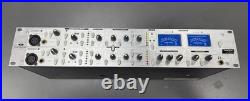
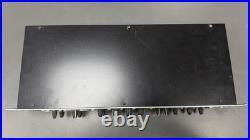
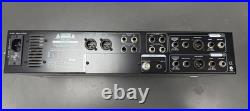
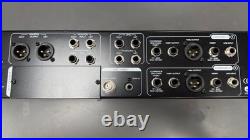

The Focusrite MH443 TwinTrak Pro Platinum Series 2-Channel Preamp/Compressor is a high-quality audio equipment designed for musicians and DJs. With its renowned brand reputation and dual channels, this preamp/compressor is perfect for professional sound engineering tasks. The product is known for its exceptional performance and reliability in enhancing and controlling audio levels with precision and clarity. Ideal for live performances, recording sessions, or studio playback, the Focusrite MH443 TwinTrak Pro Platinum Series is a top choice for those seeking professional-grade audio equipment. Gain range = 0 dB to 60 dB continuously variable. Input impedance = 50 Ohm to 3K3 Ohmcontinuously variable. EIN = 128 dB measured at 60 dB of gain with 150 Ohm terminating impedance and 20 Hz/22 kHz bandpass filter. THD at minimum gain (0 dB) = 0.0004% measured with +16 dBu input signal and with a 20 Hz/22 kHz bandpass filter. THD at maximum gain (60 dB) = 0.003% measured with a 36 dBu input signal and with a 20 Hz/22 kHz bandpass filter. THD at maximum input level (26.5 dBu) = 0.005% measured with a 20 Hz/22 kHz bandpass filter. Frequency response at minimum gain (0 dB) = flat at 10 Hz and 2 dB down at 200 kHz. Frequency response at maximum gain (60 dB) = 2 dB down at 10 Hz and 200 kHz. CMRR at full gain (60 dB) = 80 dB. Gain range = -10 dB to +10 dB continuously variable. Input impedance = 10K Ohm from 10 Hz to 200 kHz. Noise at main output with gain set to 0 dB = -94 dBu measured with a 20 Hz/22 kHz bandpass filter. Noise at 10 dBV output with gain at 0 dB = -100 dBu measured with a 20 Hz/22 kHz bandpass filter. Signal to noise ratio relative to max headroom (27 dBu) = 121 dB. Signal to noise ratio relative to 0 dBfs (+22 dBu) = 116 dB. THD at unity gain (0 dB) = 0.0006% measured with 0 dBfs (+22 dBu) input signal and with a 20 Hz/22 kHz bandpass filter. Frequency response at unity gain (0 dB) = 0.1 dB down at 10 Hz and 3 dB down at 200 kHz. Gain range (High Gain switch out) = 0 dB to 20dB continuously variable. Gain range (High Gain switch in) = 20 dB to 40dB continuously variable. Input Impedance = > 1 Meg Ohm. Noise at minimum gain (0 dB) = -90 dBu measured with a 20 Hz/22 kHz bandpass filter. Noise at maximum gain (40 dB) = -78 dBu measured with a 20 Hz/22 kHz bandpass filter. THD at minimum gain (0 dB) = 0.006% measured with 10 dBu input signal and with a 20 Hz/22 kHz bandpass filter. Frequency response at unity gain (0 dB) = 0.5 dB down at 10 Hz and 1 dB down at 200 kHz. Frequency response at maximum gain (40 dB) = 6 dB down at 10Hz and 1dB down at 200KHz. 6 LED peak reading meter is calibrated relative to 0 dBfs where 0 dBfs = +22 dBu (the maximum level which can be correctly converted by the optional internal A/D converter before overload occurs). The meter calibration points are as follows. Meter panel calibration value Equivalent dBu value. 0dBfs +22dBu (the maximum level the ADC can convert before digital distortion occurs). 18dBfs +4dBu (the normal signal level in an analogue system to allow headroom for additional processing such as EQ). Unbalanced input and output on balanced (TRS) socket as follows. Tip = Send (Output). Ring = Return (Input). Signal level equivalent to 6dB below normal operating level. Roll off = 12 dB per octave 2 pole filter. 3 dB at 120 Hz. 6 dB at 85 Hz. 12 dB at 56 Hz. Threshold hold range = -12 dBfs (10 dBu) to 42 dBfs (-20 dBu). Compressor ratio (Hard Ratio switch out) = 2.5:1. Compressor ratio (Hard Ratio switch in) = 6:1. Attack time (Slow Attack switch out) = 0.5 ms. Attack time (Slow Attack switch in) = 5 ms. Release time = 100 ms to 1 s and then auto release mode when the release knob is turned fully clockwise. Auto release creates a release time dependent upon the average level of the incoming signal. Noise = -94 dBu measured with a 20 Hz/22 kHz bandpass filter. Makeup gain = 0 to +21 dB. Can be used to input an independent signal to trigger compression or to allow the side-chain audio to be sent in and out of the unit via an external processor, such as an EQ for frequency conscious compression and de-essing of vocals. Connector is an unbalanced input and output on balanced (TRS) socket as follows. Signal level equivalent to 6 dB below normal operating level. EQ shape = Peak. Center frequency = Variable between 120 Hz and 2 kHz. Cut (Deep switch out) = -6 dB. Cut (Deep switch in) = -12 dB. Q (Deep switch out) = 1.5. Q (Deep switch in) = 3. Unbalanced output, signal level equivalent to -6 dB below normal operating level. Maximum output signal level = +20 dBu. Operating level = +4 dBu. Unbalanced output, signal level equivalent to 6 dB below normal operating level. Noise = -98 dBu measured with a 20 Hz/22 kHz bandpass filter and monitor level knob at maximum output level (fully clockwise). Maximum output signal level = +26 dBu. Playback sample frequency = 32 kHz to 192 kHz. Maximum bit depth = 24-bit. Maximum analogue output level = +21 dBu. Dynamic Range = 111 dB measured with A weighted filter. Wordclock BNC connector outputs a regenerated wordclock at the sample frequency contained within the SPDIF signal connected to the RCA connector. Calibrated for 0 dBfs = +22 dBu and indicates the level after the output fader being sent to both the internal AD converter and the TwinTrak Pro XLR output. O/L LED is lit when any section of the unit (including the headphone output) reaches a level greater than 0 dBfs (O/L: LED triggered at +22.4 dBu).